A fisherman’s guide to the weird little bait family that keeps growing
Fuzz ball baits.
How we got here—and what looks like it’s coming next.
If you have tried to keep fuzzy dice, urchins, spiky balls and Coike-style baits straight, you already know the names get messy fast. The good news is the fishing side is easier. These baits grew out of Japanese ideas, tournament discoveries, homemade experiments and a wave of U.S. releases. We are keeping track of how it all fits together so you do not have to.
ONE
FAMILY
FIELD WATCH / 001Forget winning the naming argument. The useful question is simpler: what does the bait actually look like, how does it behave, and how are guys fishing it?
Japanese rootsFuzzy dice breakoutUrchin / spiky-ball surgeSpecialized tackle next
The family
Here’s the easy way to keep the whole fuzzy-bait family straight.
Search results mix “fuzzy dice,” “fuzzy bait,” “urchin,” and “spiky ball” all the time. Rather than worrying about who is using the perfect term, look at the bait in your hand first. Shape tells you a lot more than the label does.
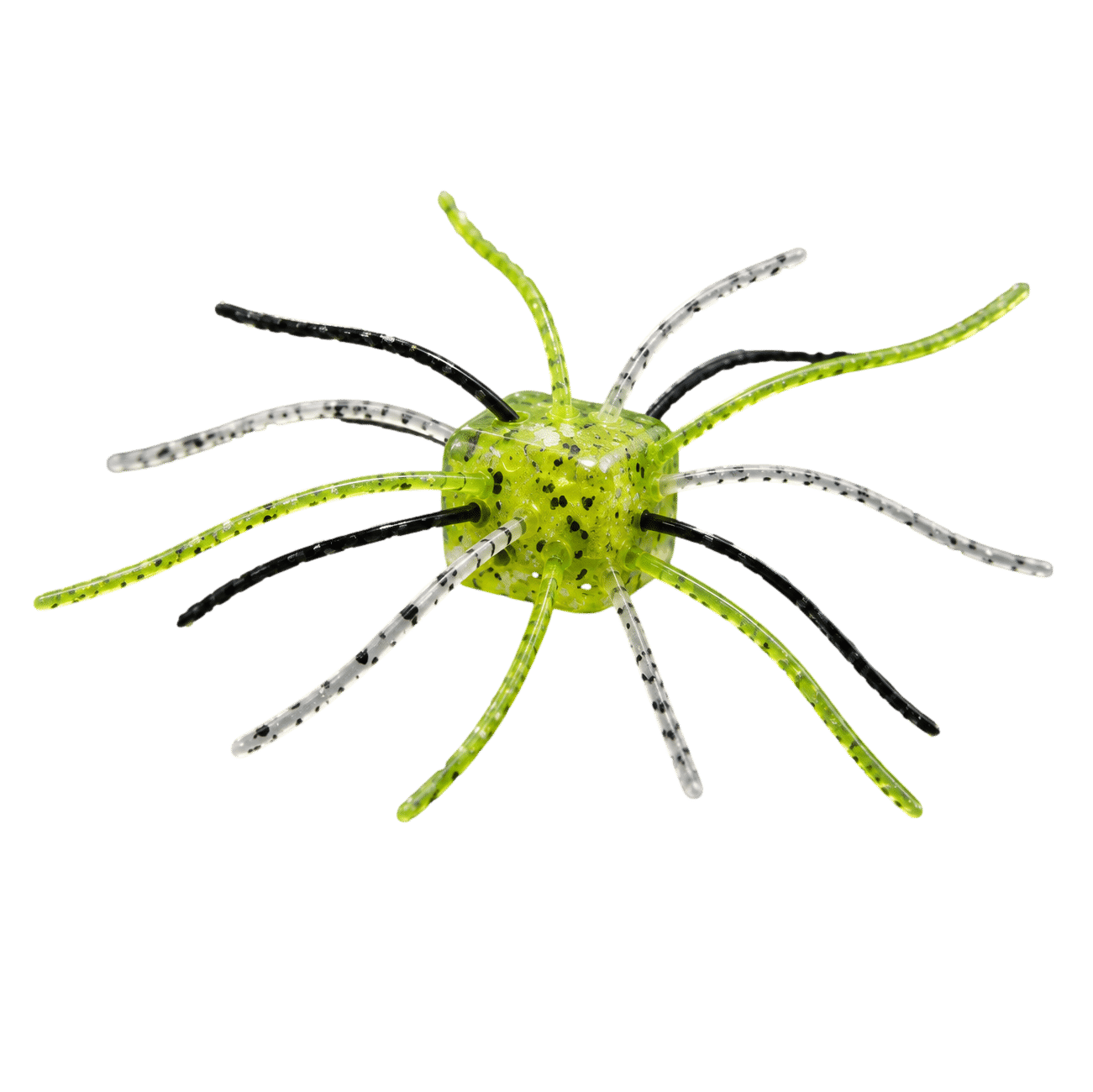
01 / FUZZY DICECube or chunk center.
The branch that gave the trend much of its U.S. vocabulary: a small block or chunk body threaded with skirt material or flexible strands. Often finesse-oriented and commonly fished weightless or on a drop shot.
Go deeper at FuzzyDiceBaits.com →02 / URCHIN / SPIKY BALLRound center, arms in every direction.
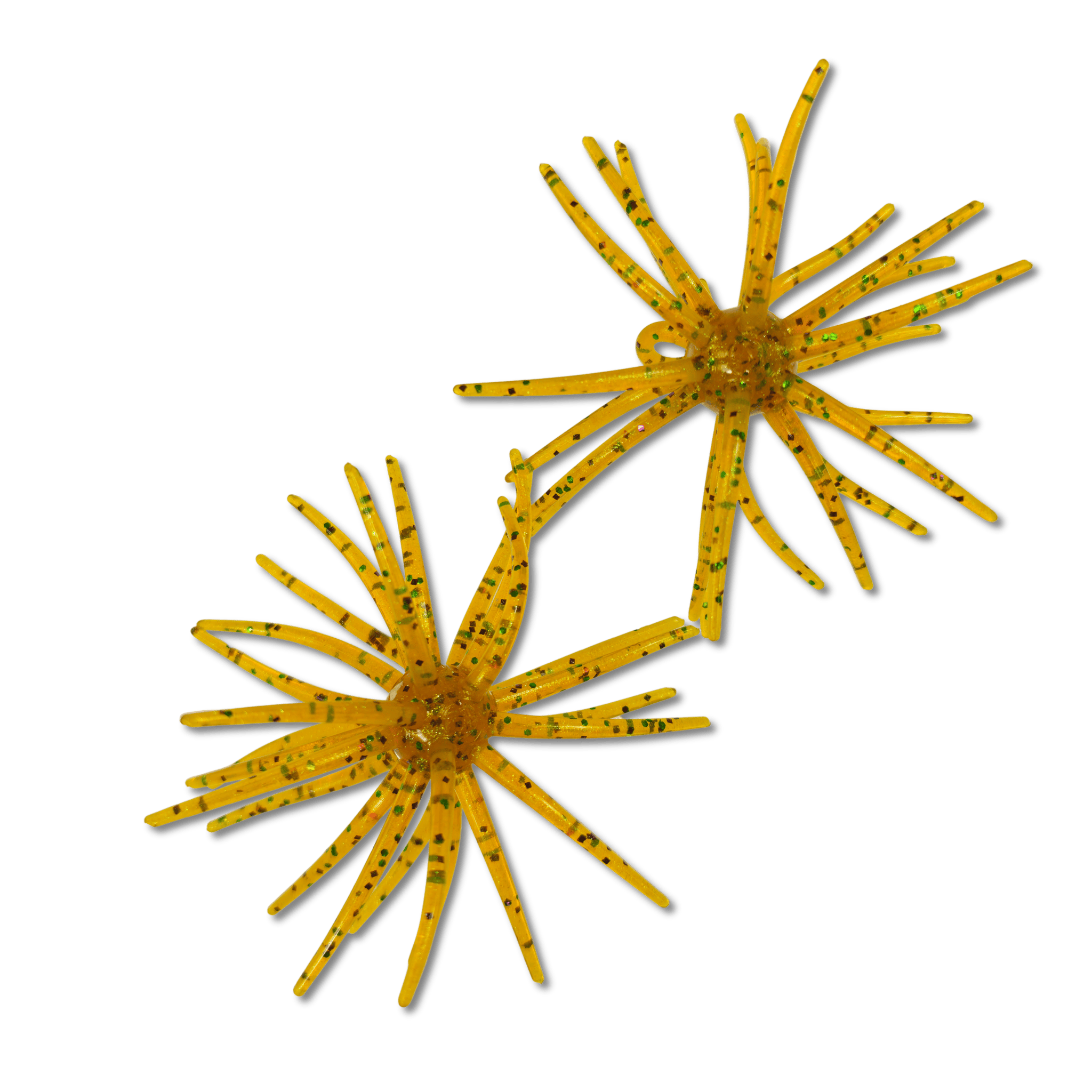
Sphere or rounded center with molded or flexible arms radiating outward. This branch became the dominant new-product story in 2026 and now spans finesse to full-size suspended-bass applications.
See the round-profile branch →03 / HYBRID FUZZY BAITSThis is where it starts getting interesting.
Makers are already playing with oval centers, cylinders, flatter bodies, mixed materials and purpose-built hardware. In other words, cube versus ball is probably just the first chapter.
See what is changing → How we got here
This craze did not suddenly appear in 2026.
The roots go back to Japan well before most U.S. anglers had one in the boat. What changed here was visibility—tournament wins, social media, easier access to the baits, and then American makers jumping in with their own takes.
Before the U.S. boom
Japanese fuzzy and Coike-style baits establish the idea.
Japanese anglers were already fishing compact, all-direction-motion baits well before they became common in U.S. tackle boxes. Retrospective sources disagree on the exact age of individual products, but they agree the roots are distinctly Japanese and much older than the current American trend.
2022
U.S. pros start getting serious Japanese intel.
Major League Fishing later reported that Alton Jones Jr. first got his hands on a Coike around 2022 after hearing that the profile had started winning tournaments in Japan.
2024
Home-built fuzzy baits prove the idea at the highest level.
Michael Neal's St. Lawrence River win with a homemade fuzzy-bait contraption became one of the strongest signs that the odd profile was more than novelty.
2025
“Fuzzy dice” becomes a mainstream U.S. tackle category.
Coverage around ICAST and tournament fishing increasingly grouped cube, spherical and other strand-covered baits under the fuzzy-dice/fuzzy-bait umbrella.
2026
The round Urchin / spiky-ball branch explodes.
Bassmaster described dice and round spiky-ball styles as two main branches, while Major League Fishing and ICAST coverage documented an avalanche of new urchin-style products and specialized rigging.
The roadmap
So where does this all go from here?
Nobody knows which name or exact shape will win out, and that is fine. What we can do is watch the things that are already changing the way these baits are built and fished.
01 / SHAPEDo not expect one “standard” fuzzy bait.
Cube and round are probably just the starting point. The basic idea is too useful: a compact center with motion going every direction. Makers are going to keep messing with that.
02 / SIZESmall and big versions are becoming different tools.
The little ones are settling into finesse jobs. The bigger urchins are heading toward suspended fish, heavier tackle and presentations where the whole silhouette matters.
03 / MATERIALMaterial is starting to matter as much as shape.
Two baits can look almost identical on the deck and fish completely differently. PVC, salt level, TPE/elastomer and mixed materials all change how they fall, float, bend and spring back.
04 / HARDWAREThe hooks and weights are finally catching up.
These are odd-shaped baits, so normal hardware does not always fit them well. That is why we are already seeing purpose-built jigheads, internal weights, specialty hooks and suspended-rig ideas.
05 / SPECIESThis probably will not stay a bass-only thing.
Shrink the same idea down and it starts making a lot of sense for crappie, panfish, trout, ice and BFS fishing. That could turn into a whole second branch of the category.
06 / LANGUAGEThe names are probably going to stay messy for a while.
Fuzzy dice, fuzzy bait, fuzz ball, urchin and spiky ball still overlap. For now, know the shape and the job. The vocabulary will catch up eventually.
What to watch
This is the fun part: we get to watch the category grow up.
We are past the point of asking whether these things catch fish. They do. Now we get to see which versions become tackle-box standards and which ones turn out to be a short-lived craze.
01 / TOURNAMENT ADOPTIONWho is still throwing them after the hype settles down?
One big tournament can start a craze. Seeing good anglers keep them tied on across different lakes is what tells you the technique has real legs.
02 / PRODUCT SPECIALIZATIONAre makers actually building different tools?
A healthy category eventually moves past copycat shapes. The better sign is when different baits are clearly built for different jobs.
03 / TERMINAL TACKLESpecialized hardware is a pretty good clue this is sticking around.
Once companies start building hooks, weights and heads specifically for these baits, you know we are getting beyond a one-season novelty.
04 / SEARCH LANGUAGEListen to what fishermen actually start calling these things.
If “fuzzy dice,” “urchin,” “spiky ball” and “fuzz ball” start meaning obviously different things to anglers, the subcategories will have sorted themselves out naturally.
Current sources
A lot of this story is still being written right now.
These are the articles we keep coming back to as the category develops. They do not all use the same words—and that is part of the point. Outside source links open in a new tab.
Want to dig into the story a little farther?
Think of Fuzz Ball Baits as the place where we keep the whole family straight. The branch sites go deeper when you want to nerd out on one specific profile.